How big should our filter plant be to process X,000 tonnes per day?
There are some extremely simple, but crucial, questions to ask when making the decision whether, or not, to adopt filtered tailings. Among the first should be:
- How big should the filters be and how many of them would we need?
- What about cake properties for stacking or creating paste for backfilling?
- How much water can we recover?
In turn, this requires answers to a number of other questions:
- How does our slurry de-water, what volume of filter cake can a particular filter make per day?
- for a batch filter this requires the volume of cake per batch and the number of batches per day.
- for a continuous filter this requires a volume of cake per unit time.
- what are the properties of this filter cake?
The volume of cake that a filter is capable of producing will depend upon:
- Process Factors: The inherent rate at which the slurry will dewater, depending upon the motive force (pressure for example) and resistance to flow of water through the cake.
- Machine Factors: For batch pressure filters, the time taken by the machine to perform its non-process operations, for example cake discharge, valve operations, pressure relief. For continuous vacuum filters this is the speed at which belts or discs can move.
- What is the likely plant uptime?
In a sentence: How quickly can we make filter cake with the required properties and how quickly can we remove it from the filter?
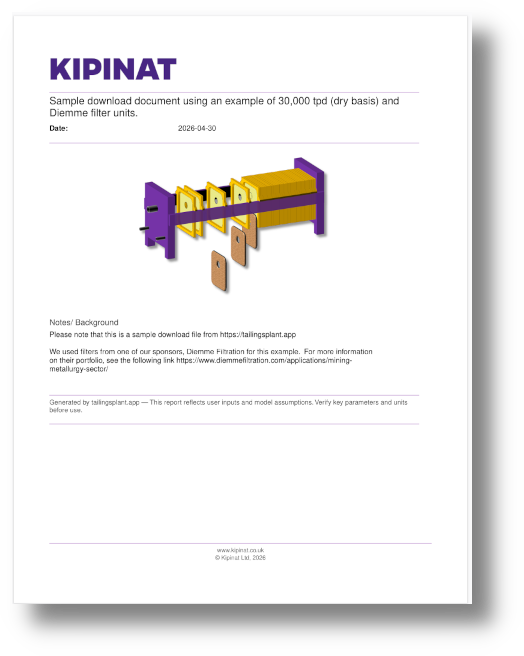
For this case, we use tailingsplant.app’s filter plant calculator to look at these questions for a 30,000 tpd copper tailings plant incorporating filtration equipment from Diemme Filtration (large filter presses). The input parameters used — and therefore the outputs — are reasonable, but reliable results ultimately depend on having adequate test data from your specific tailings slurry. Attached is an example of the output file generated by the filter plant calculator in tailingsplant.app.
The workflow is intuitive, and you are invited to put this article on your screen, next to a session, and click along.
Step 1. Simple Process Design Criteria
You simply need to provide the Slurry Parameters that you have for your tailings slurry (generally this is considered to be pre-thickened to >55%w/w solids). Here, you select one parameter to be unknown, and this will be calculated based on the other three. (If you already have values for all four then this can serve as a useful check.)
Next enter the Daily Throughput in metric tonnes, dry solids, per day and Expected Availability of the filtration plant. If a plant has redundancy, then this can be put at 100% as a base case. The calculator then produces a simplified table of Mass and Volume reporting to the filter plant of solids, liquids and total slurry.
Generally, if you are going to produce a download of your work, it is good practice to put the source of your inputs in here (it might be from a previous study, or come from a verbal communication). Also, note that the calculator inputs are persistent, so you can close your web browser, turn off your computer and, when you reboot and reopen the app, your session will still be there. To reset all values and comments fields, go to the Download/ Reset tab. 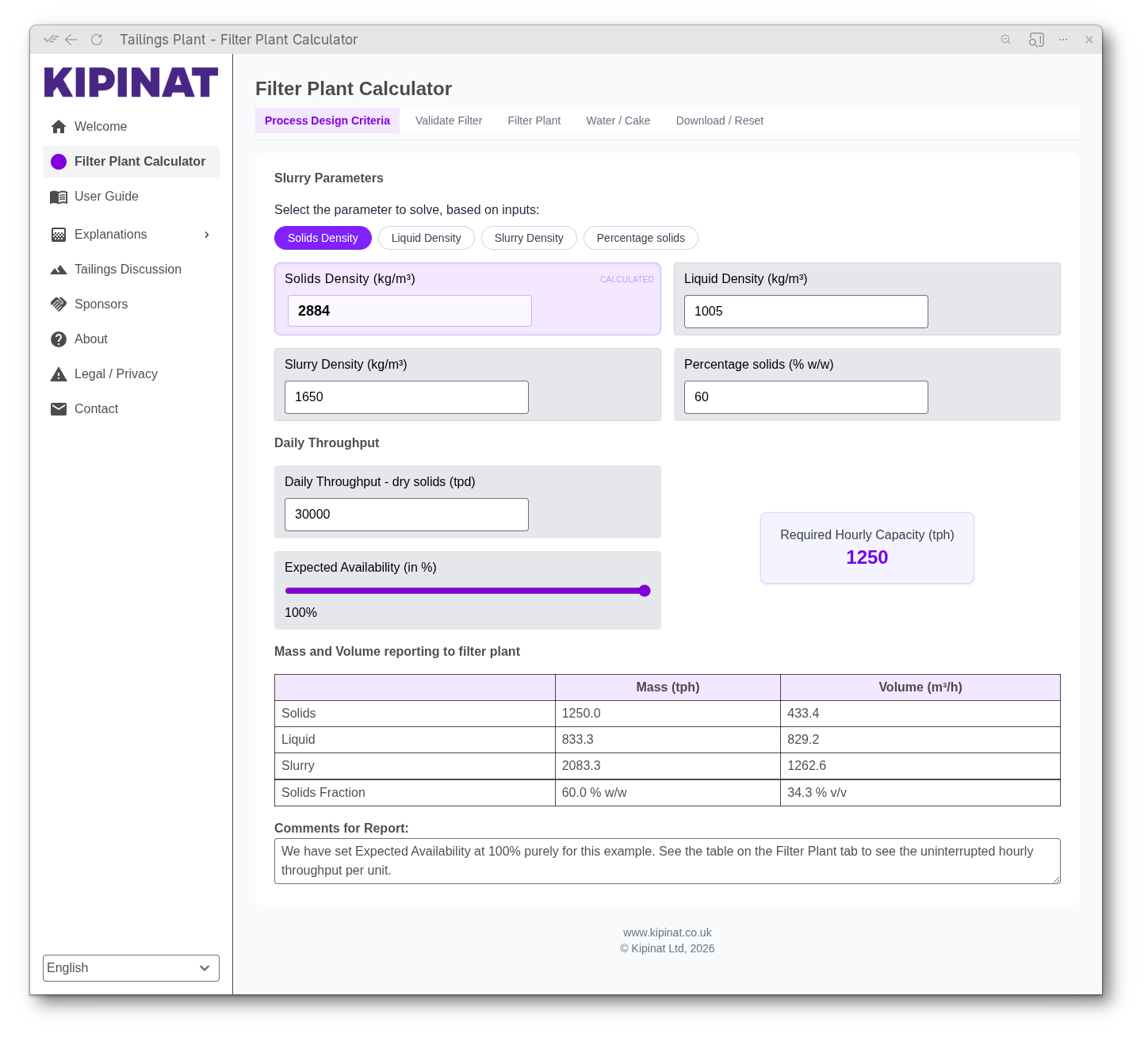
Step 2 Validate Filter
Next, you will enter what you know about how your slurry dewaters using the Filter Type that you select, in this case we have chosen Filter Press.
These values can be established with a simple set of tests. When considering the Total Cycle Time it is necessary to have information from possible vendors or from your actual equipment.
Overall, however, the numbers shown below are reasonable for a relatively typical copper tailings slurry fed to a filter press.
The calculator now provides a Specific Capacity in kg/(m²h) or, in word, kilograms per square metre, per hour. In this case 153 kg/(m²h). So, if you had a filter press with 1000 m² filtration area and a cycle time of 15 minutes, cake porosity of 47% v/v and cake thickness 50 mm then the throughput in 24 hours of uninterrupted uptime will be
kg
or 3,670 tonnes per day. 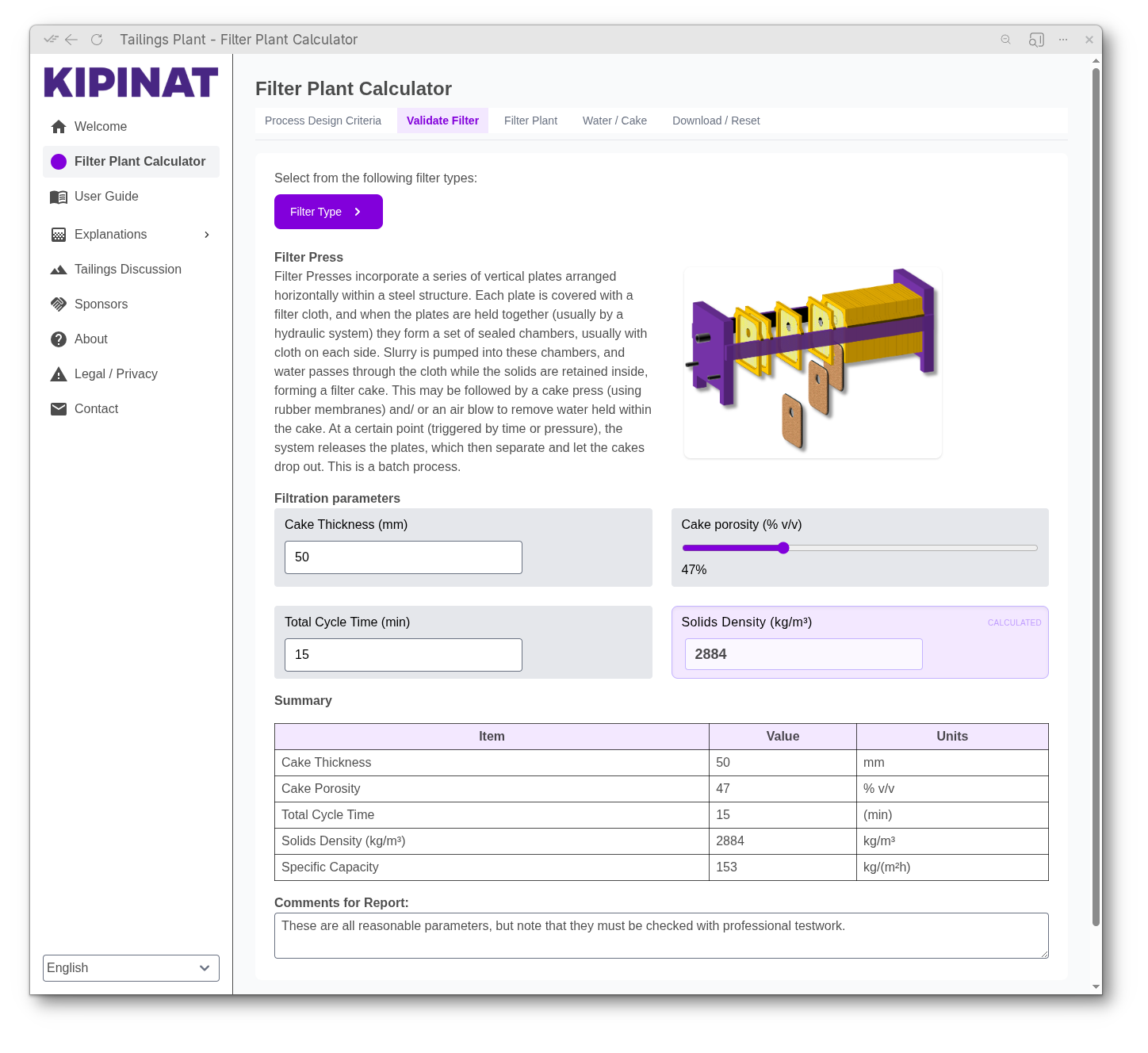
Step 3 Filter Plant
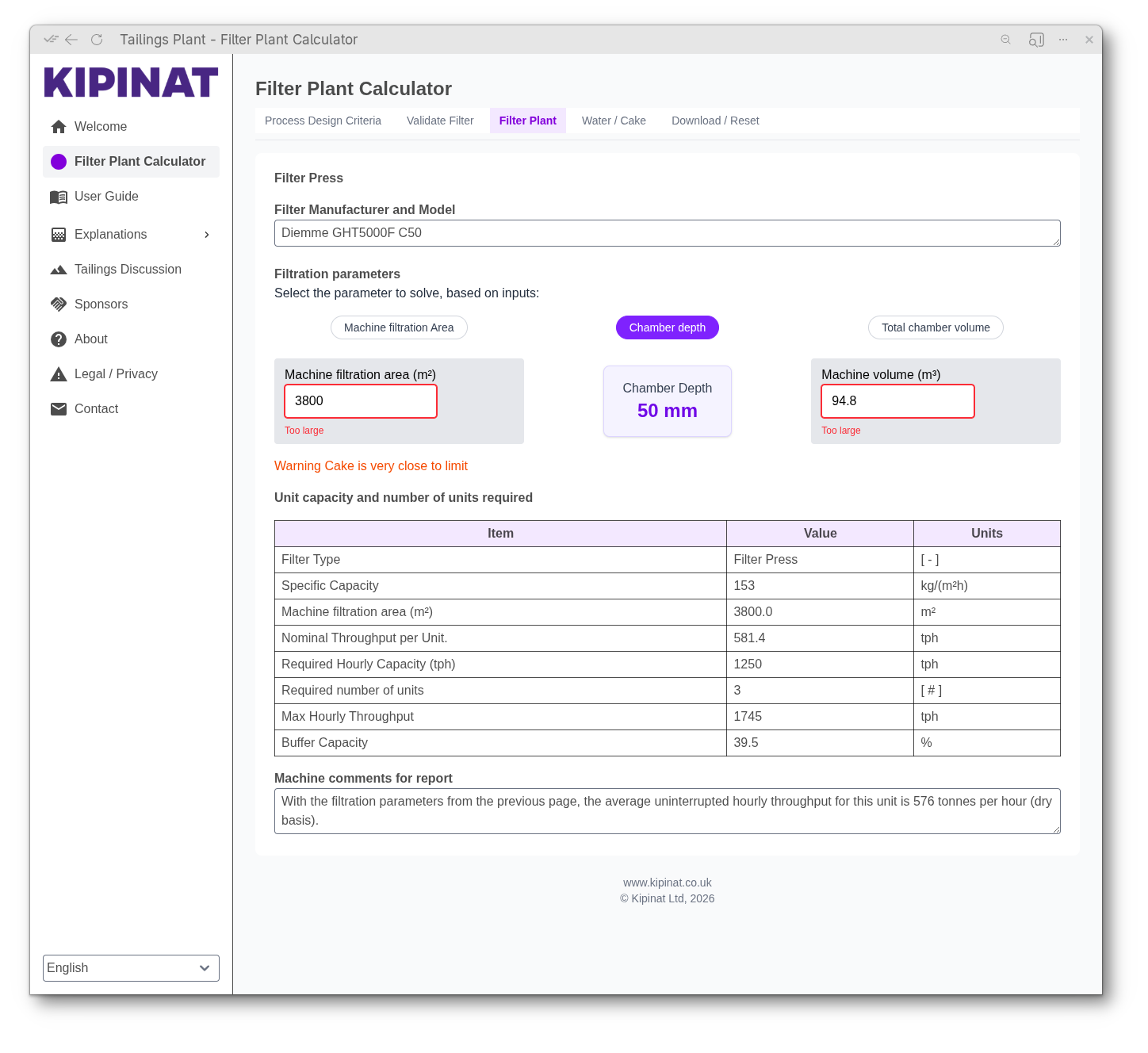
Next you will enter the Filtration Parameters for the filter in question. Here we are using the specification provided on Diemme Filtration’s website. (Note that the app gives a warning that these are too large, this is because this filter is both the world’s largest and new. The app will be updated to reflect this. Also, note that the app will still calculate correctly despite the warnings.)
The calculator now gives a nominal throughput of 580 tonnes per hour. In Step 1. we established a required hourly throughput of 1,250 tph, so the calculator tells us that we need 3 such units in order to fulfil this duty and that, with all filters operating at full capacity, there would be a buffer of around 40%.
From this you can make decisions about the number of filters to install.
Step 4. Water/Cake
At the conceptual study stage, you may now have enough information to engage with vendors or engineering companies to take this further. However, The app also can be used to go further and calculate Maximum Water Recovery and also some useful Cake Properties. Again, there is no substitute for real-world confirmation, but as a rule-of-thumb, for a pressure filter after a typical air-drying duration, the Water Volume Fraction (the blue band in the phase volume chart) is about the same as the Air Volume Fraction (the grey band): 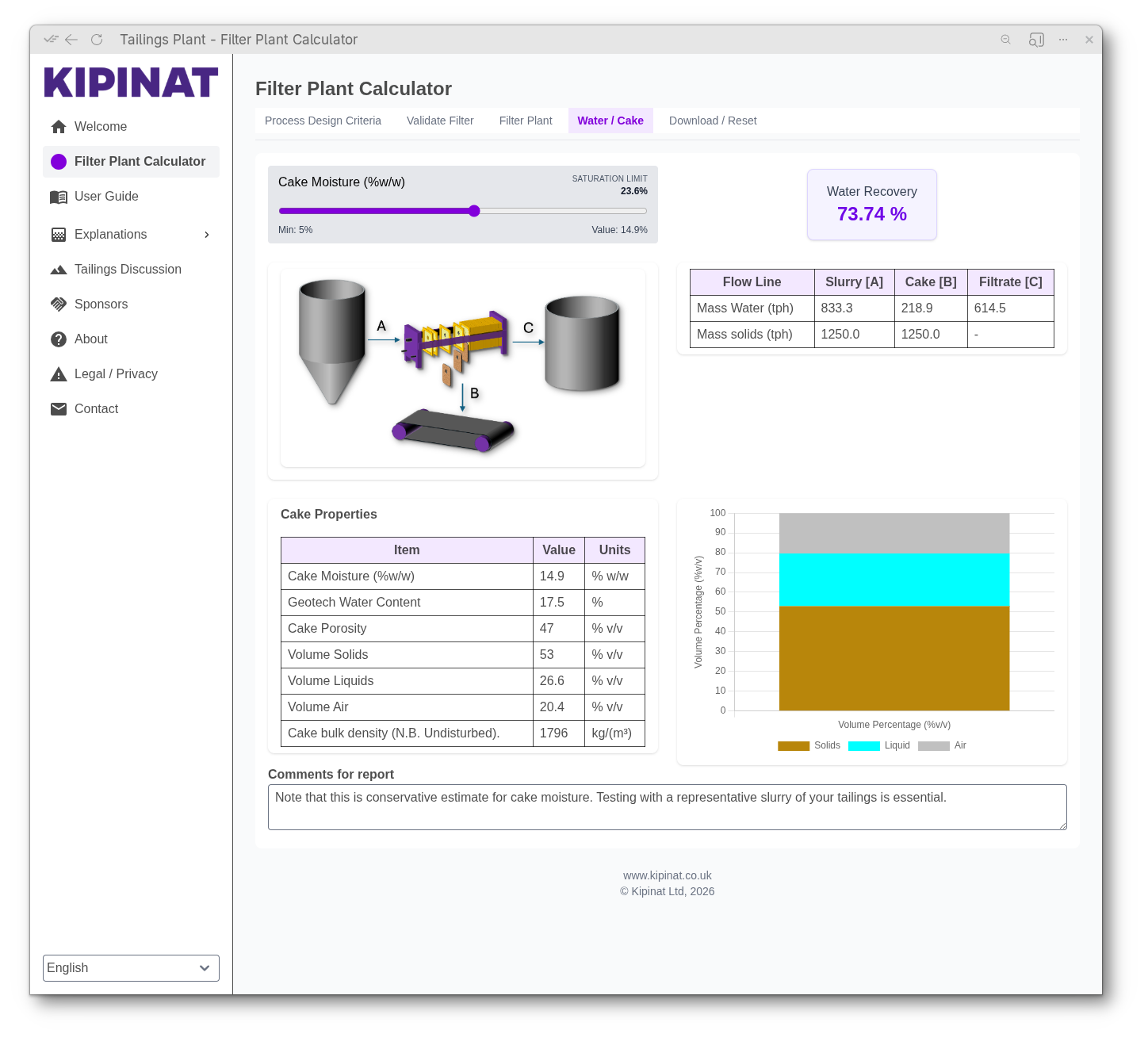
Step 4. Download/ Reset.
Finally, having put in all of this work, it makes a lot of sense to preserve it so that you can share with colleagues, vendors and other parties or simply keep a copy for your record.
You can be as descriptive and/ or poetic as you wish, but include as much as you can so that the next person looking at your case can have a full understanding of the choices that you made. 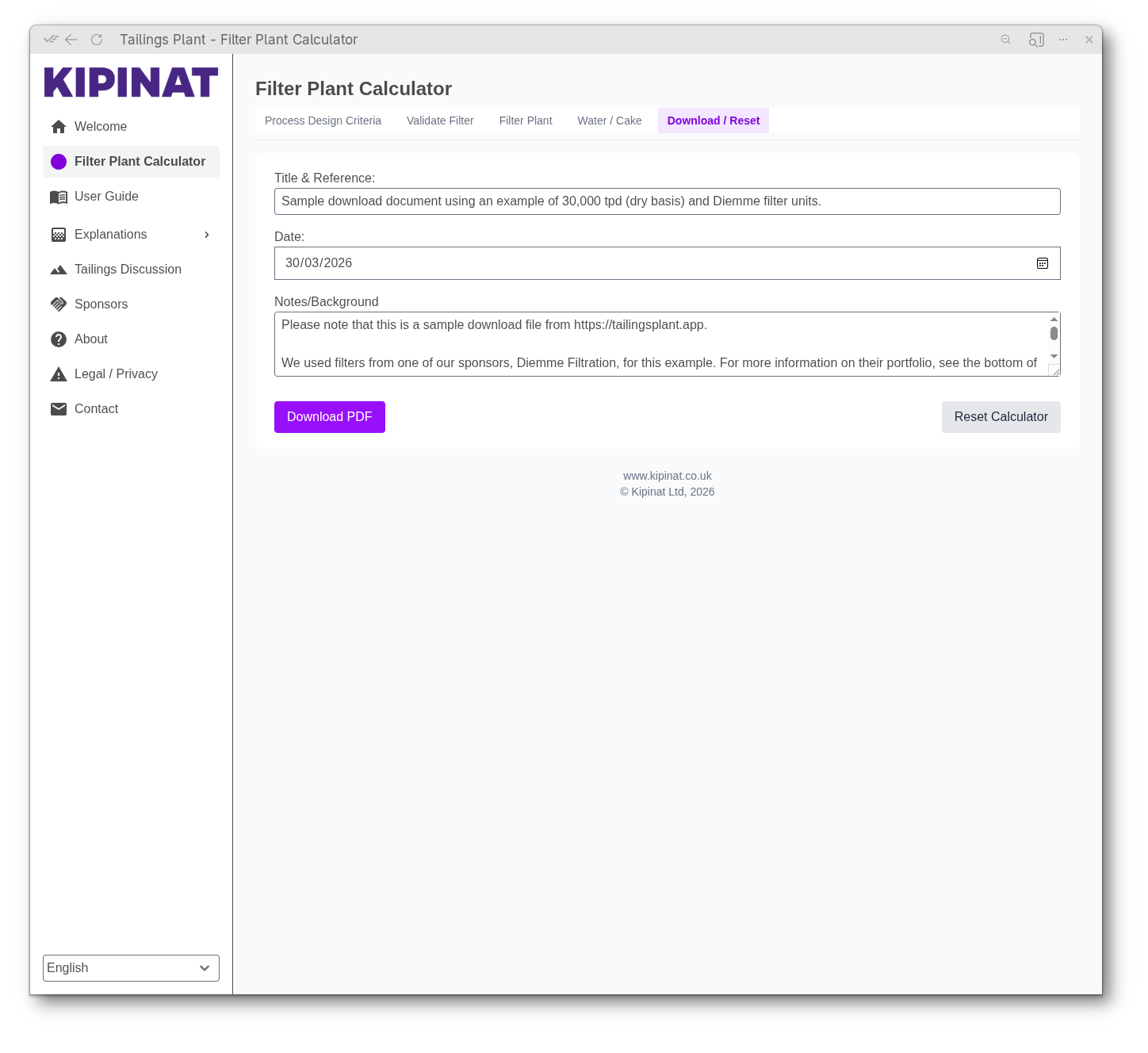 Our goal is simple: make the application Useful, Accurate, and Freely Available to use or share. This is made possible thanks to the support of Diemme Filtration and other partners who help keep the platform open to the industry.
Below is the output file generated using these inputs.