
Sizing example — ceramic vacuum disc filters
10 August 2026
Introduction/ Background
There are some simple (but vital) questions to ask when making the decision around the adoption of filtered tailings. Among these should be:
- What filtration technology (i.e. what type of filter)?
- How big should the filters be and how many of them would we need?
- What about cake properties for stacking or creating paste for backfilling?
- How much water could we recover?
- …?
For this article, we are using tailingsplant.app’s filter plant calculator to look at some of these questions for a 6,500 tpd copper tailings plant incorporating ceramic disc filtration equipment. The input parameters used — and therefore the outputs — are reasonable for a typical gold tailings, but reliable results ultimately depend on having adequate test data from a your specific tailings slurry, ideally covering a range of conditions to allow for upstream disturbance of your process.
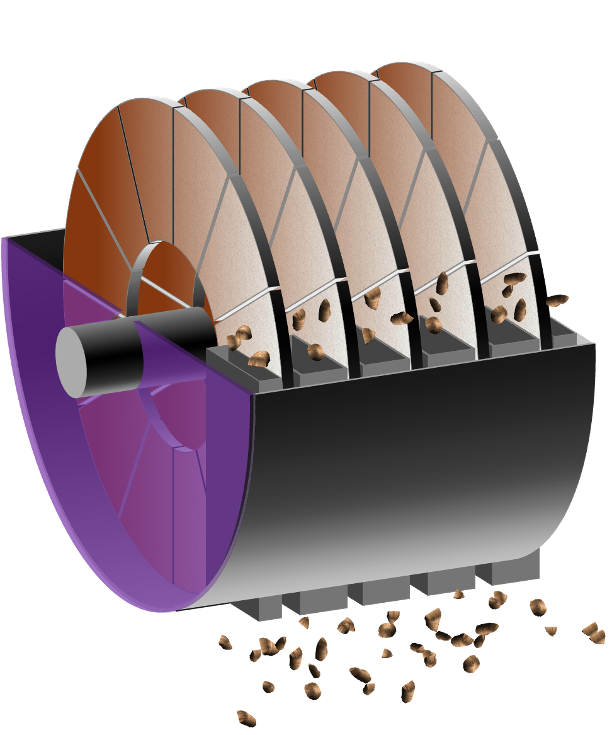
While it is not possible to have a general best-available-technology for tailings (or mineral concentrate) filtration, there will be operations where ceramic discs offer a very compelling proposition. They can, in a number of scenarios, offer the following favourable outcomes:
- Very low energy consumption — no air passes through the filter medium so the vacuum pump motors are extremely small compared with those used in conventional (i.e. cloth) vacuum disc or belt filters
- Extremely long-lasting filter media — a structure of sintered fine alumina particles
- Notably clear filtrate — thanks to the very fine, sintered ceramic filter media
- Relatively simple plant layout — given that they operate continuously, there is less need for slurry and cake buffering.
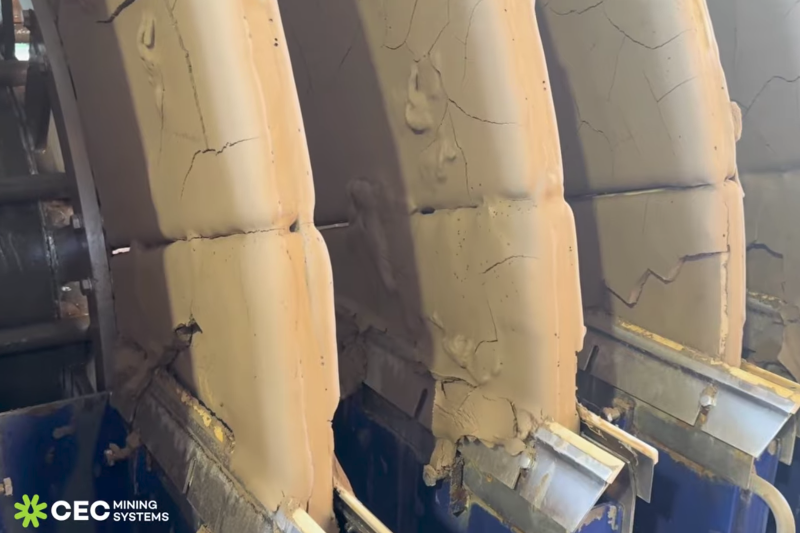
It is not the purpose of this article to give the full breakdown of those physical phenomena at play in this form of dewatering, but we can run through a sizing exercise. For more information, take a look at our explanation article on disc filters or speak with CEC Mining Systems, one of the sponsors of this app. The image below links to a video of a unit operating.
A simple sizing exercise
In order to establish the solids-processing capacity of the filter that we are assessing, we require answers to a number of other questions:
- How does our slurry de-water, what volume of filter cake can a particular filter make per day?
- What are the properties of this filter cake?
The volume of cake that a filter is capable of producing in any given time period will depend upon:
- Process Factors: Principally the inherent rate at which the slurry will dewater, depending upon the motive force (vacuum for example) and resistance to flow of water through the cake and media.
- Machine-specific Factors: For continuous vacuum filters this is the speed at which belts or discs can move, while still producing a filter can that is thick enough for effective discharge and allowing for effective removal of filtrate.
- What is the likely plant uptime?
Process Design Criteria
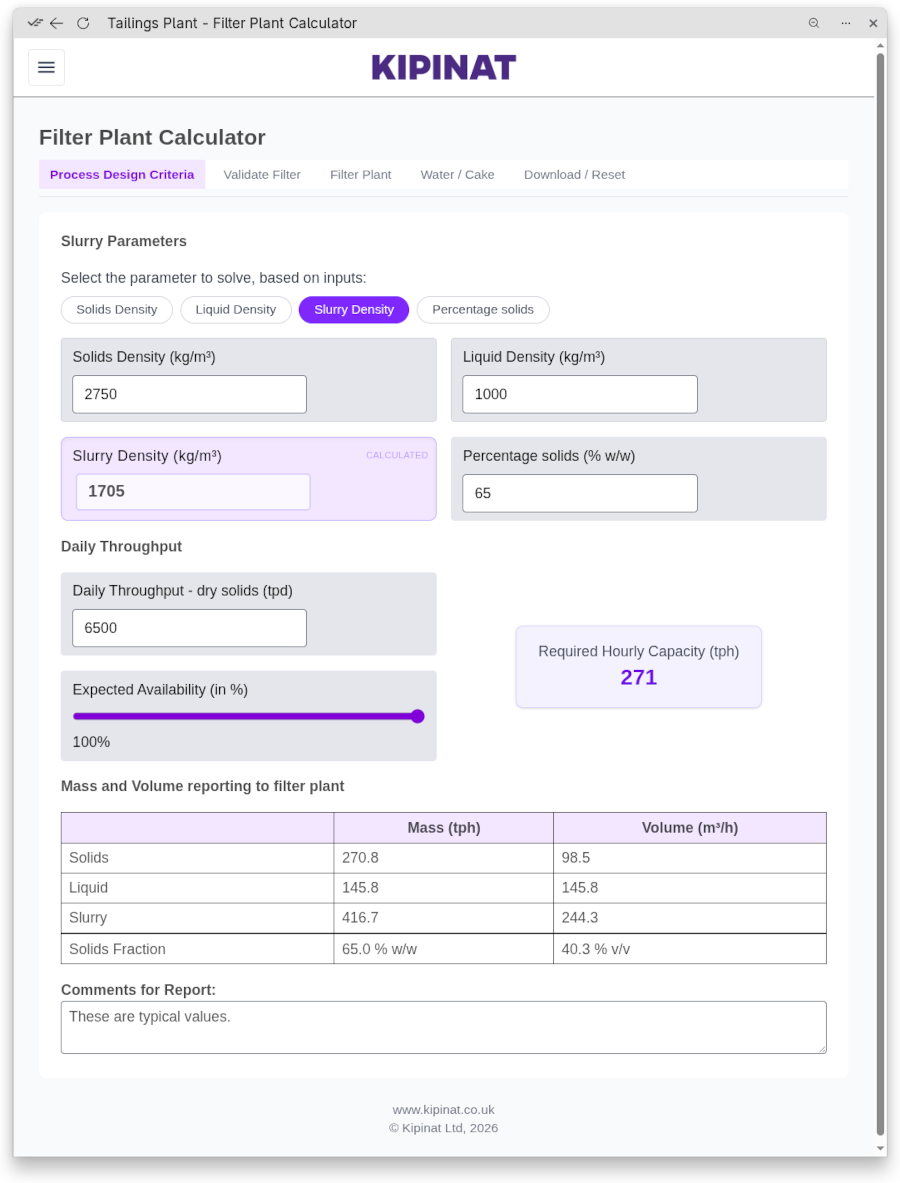
The workflow is intuitive, but you might find it useful to open a session of tailingsplant.app (just point you browser there) and click along. This exercise will take a tailings duty of 6,500 tonnes per day (tpd), with the following solids, liquid and slurry parameters:
| Parameter | Units | |
|---|---|---|
| solids density, | 2,750 | |
| liquid density, | 1,000 | |
| percentage solids | 65 |
Putting these into the app, we calculate the slurry density as well as volumes and masses reporting to the plant. This will be useful for sizing pumps and tanks later, if you proceed to a more detailed process:
Testing times
You may have some knowledge of the inherent filterability of your slurry, the rate at which water can pass through the cake as it forms, but it is still essential to use testing where possible. Below is an outline, but not comprehensive, testing process. Vendors, universities, consultants or dedicated testing laboratories will have their own detailed processes, or you could create your on from this outline. For this we’ll need:
- a good sample of slurry
- a ceramic leaf tester and associated kit
- laboratory vacuum pump
- filtrate receiver
- weighing scales
- vessel (i.e. large bucket) with an impeller that will contain the slurry
- sealable plastic bags for cake samples, bottles for filtrate samples
- Personal Protective Equipment (PPE) — gloves, overalls,
- sink, fresh water etc., for cleaning…
- a tailingsplant.app session — just go to the URL
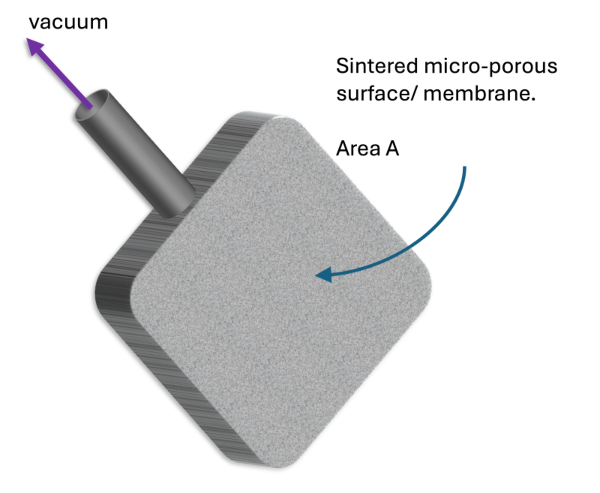
The ceramic leaf tester will consist of a small (typical tens of ) section of media with a pipe for liquid to pass through the surface of the media to a vacuum receiver (which might be a conical vacuum flask at small scale).
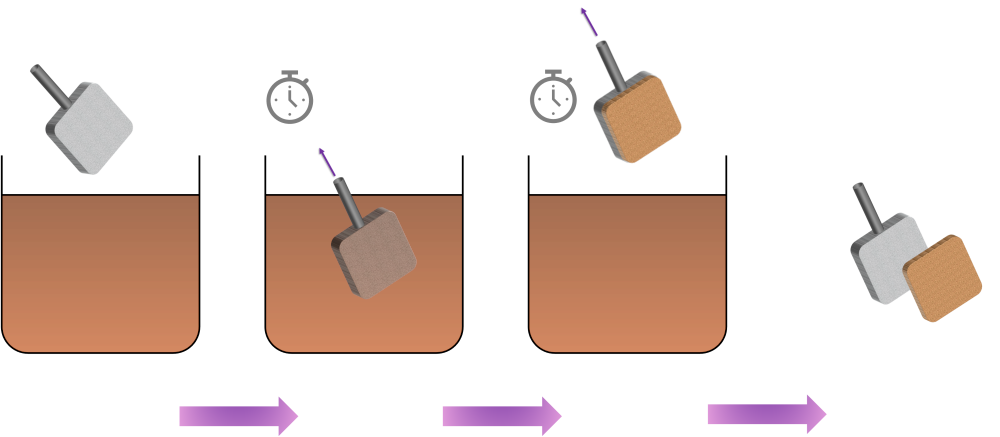
An extremely simple description of a testing process can be:
- Submerge the test leaf into the slurry
- Apply vacuum, timed to represent:
- the cake-formation phase of the rotation, when the sector would be submerged in slurry
- the draining-phase after the sector has emerged from the slurry trough and air is drawn into the cake (but, crucially, not through the surface of the filter media)
- Cut vacuum
- Remove cake sample, measure cake thickness, moisture and determine porosity.
A simple, and sufficiently accurate, method for finding the filter cake porosity, , from test work is:
- to take a sample of cake and find its volume and total mass
- It is often simple to take the whole cake, in which case the volume is simply:
- Find the cake moisture, expressed as a total water divided by total cake
- you might do this by weighing before and after drying in an oven, for example.
- then:
| Symbol | Units | |
|---|---|---|
| filter cake porosity | % v/v | |
| total cake weight | kg | |
| cake moisture | % m/m | |
| solids density | kg m-3 | |
| face area of cake | m2 | |
| filter cake thickness | m |
(Note that you can substitute another method of finding the cake sample volume — replacing with this value.)
Now, suppose that you have found the following parameters from your testing:
| Parameter | value | Units |
|---|---|---|
| cake thickness | 10 | mm |
| cake porosity | 56 % | - |
| Disc speed | 1 | rpm |
| cake moisture | 19.5 |
Filter Validation
Taking the data from the table above, we will establish a processing throughput per square meter, per hour, as the key for scaling up to our 6,500 tpd.
Putting the first three rows of our test results into the Validate Filter tab in the calculator:
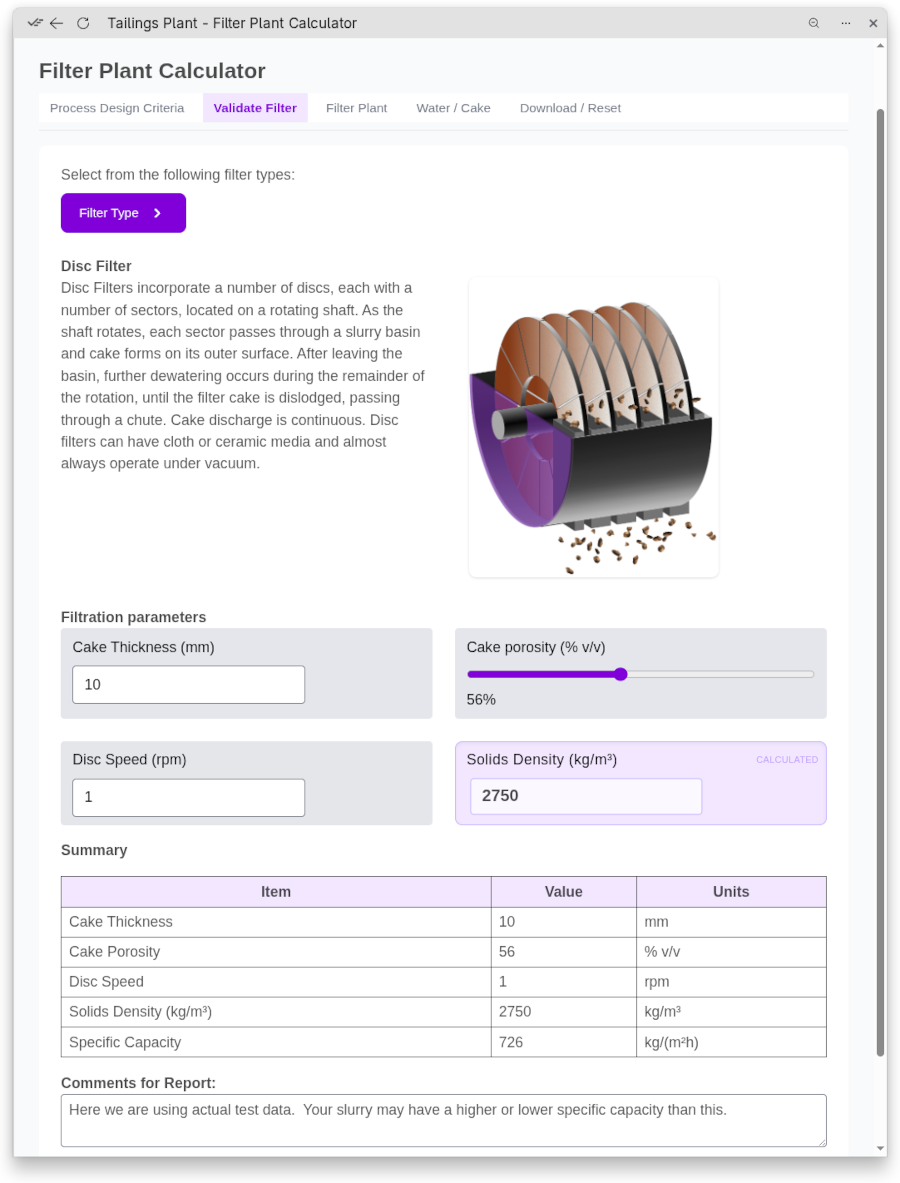
We get a specific capacity (how much this filter could process under the same conditions at full scale) of 726
Filter Plant
Then, on the next tab, we input the specification of the CX12-204 model from CEC Mining Systems, in order to see its processing capacity and establish the number of units required in operation:
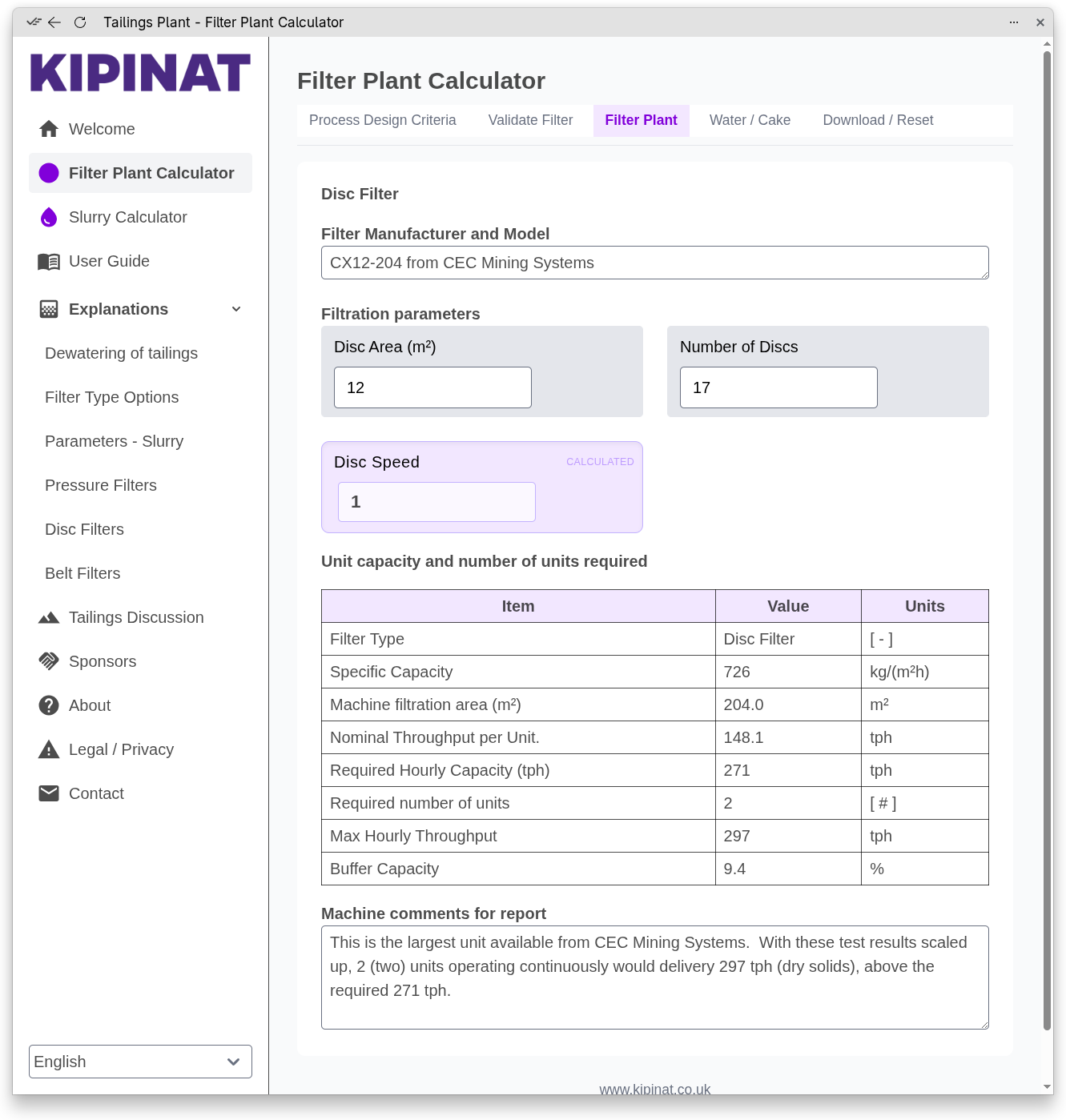
We see that two of these units, running continuously, with the the operating parameters and outputs found in the testing will deliver our required capacity, with some capacity to spare.
Finally, Water/ Cake
Finally, inputting the cake moisture obtained through testing on the Water/ Cake tab, we can take a look at the volume of filtrate collected (in Tank C below), as well as the cake phase volume breakdown: 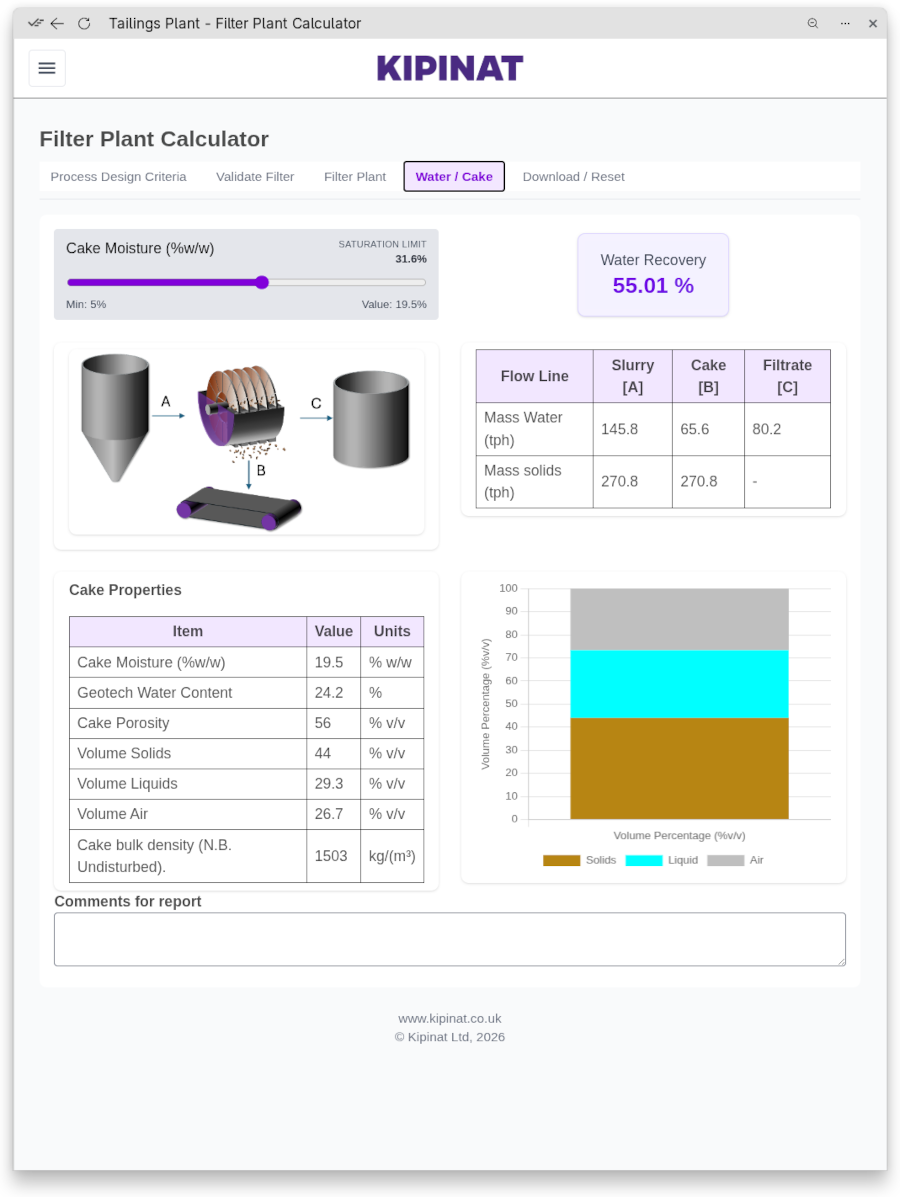
Download
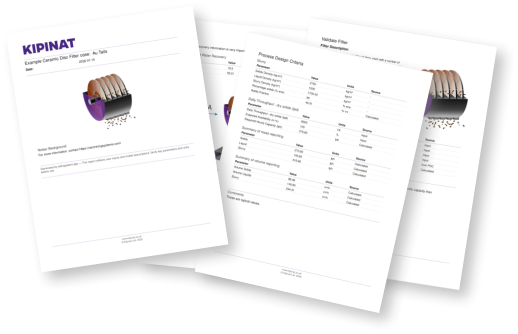
You can now download the results of your sizing exercise on the last tab. The image below is a link to the downloaded pdf file for this example.
So…
Our test work, together with the tailingsplant app have provided an indication of the likely size and number of ceramic disc filter units needed in our filter plant, as well as the volumes of water, slurry and some cake properties that we can use to support our decisions.
If you are looking for more information CEC Mining Systems will be pleased to talk with you.