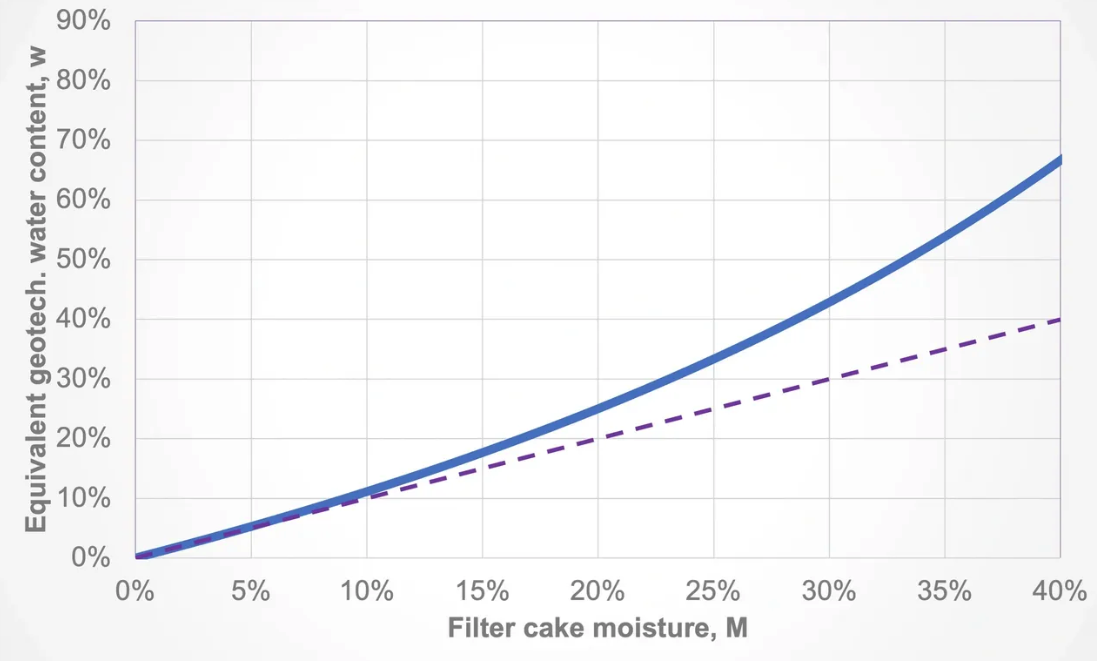
Cake moisture vs. Water Content
A note to remind folks, me included, that geotechnical engineers and mineral processing engineers define soil moisture and cake moisture differently. Since the former may use filter cake as a construction material, and moisture is a critical factor in the stability of slopes, this could be a major issue (especially at higher moistures where the difference can be large). A tailings dam engineer asking for water content may receive an answer that is several percentage points away by their understanding, due simply to this difference. For a geotechnical requirement of, say, 19% water content, the filter cake moisture might be given as 18%. All looks good, but in fact this represents a water content of ~22% to a geotechnical engineer.
Neither is better than the other (it’s not like Campagnolo vs. Shimano), but the differences must be recognised and taken into account.
So to definitions:
- Soil water content, w, is the ratio of the mass of liquid (water) to the mass of solids. This is the definition used by geotechnical engineers.
- Filter cake moisture, M, is the ratio of the mass of liquid in the cake to the total mass of the cake (solids + liquids). This is the number a mineral processing or filtration engineer works with.
This is simple enough, but everyone that I know who works around this interface has come across this issue, with varying degrees of pain. The difference is not so large as low moistures (clearly they are exactly the same at zero moisture), but the difference can grow sharply.