
Paste Backfill
Paste backfill transforms tailings waste into an engineered material used to fill mined-out stopes, providing ground support, reducing surface storage, and improving orebody recovery.
David Coulton of Retic Systems outlines key design considerations for effective paste backfill systems.
Over recent years, paste backfill has become an increasingly popular choice for underground operations. Despite its higher capital costs and operating complexity, compared to the alternatives: rock and hydraulic backfill, it presents a wide range of operational benefits including:
1. Repurposing Tailings Waste – paste backfill is primarily composed of tailings materials as a result paste backfill systems can significantly reduce the size of surface tailings facilities by stowing up to 70% of the tailings underground.
2. Engineered Product – the composition of paste backfill can be adjusted, either by controlling water or binder content or carrying out process modifications. The result is a fill that can target specific geometries, ground conditions, or exposure sequences. Coupled with representative QAQC testing, paste backfill can provide predictable performance.
3. Dedicated Equipment – paste backfill systems consist of a preparation plant (paste plant) and a network of pipes (reticulation system) to deliver the backfill to the stopes. This system operates independently and frees up equipment (LHDs) for production purposes.
The first stage of a paste backfill system is the paste plant; these are almost exclusively located on surface and take the raw tailings stream from the processing plant. There are two key process operations within a paste plant - dewatering and mixing. Dewatering typically takes place over two stages with a high-rate thickener and then disc filters or filter presses. The tailings filter cake is then blended with a binder, trim water / slurry, and occasionally additives to form the final paste product.
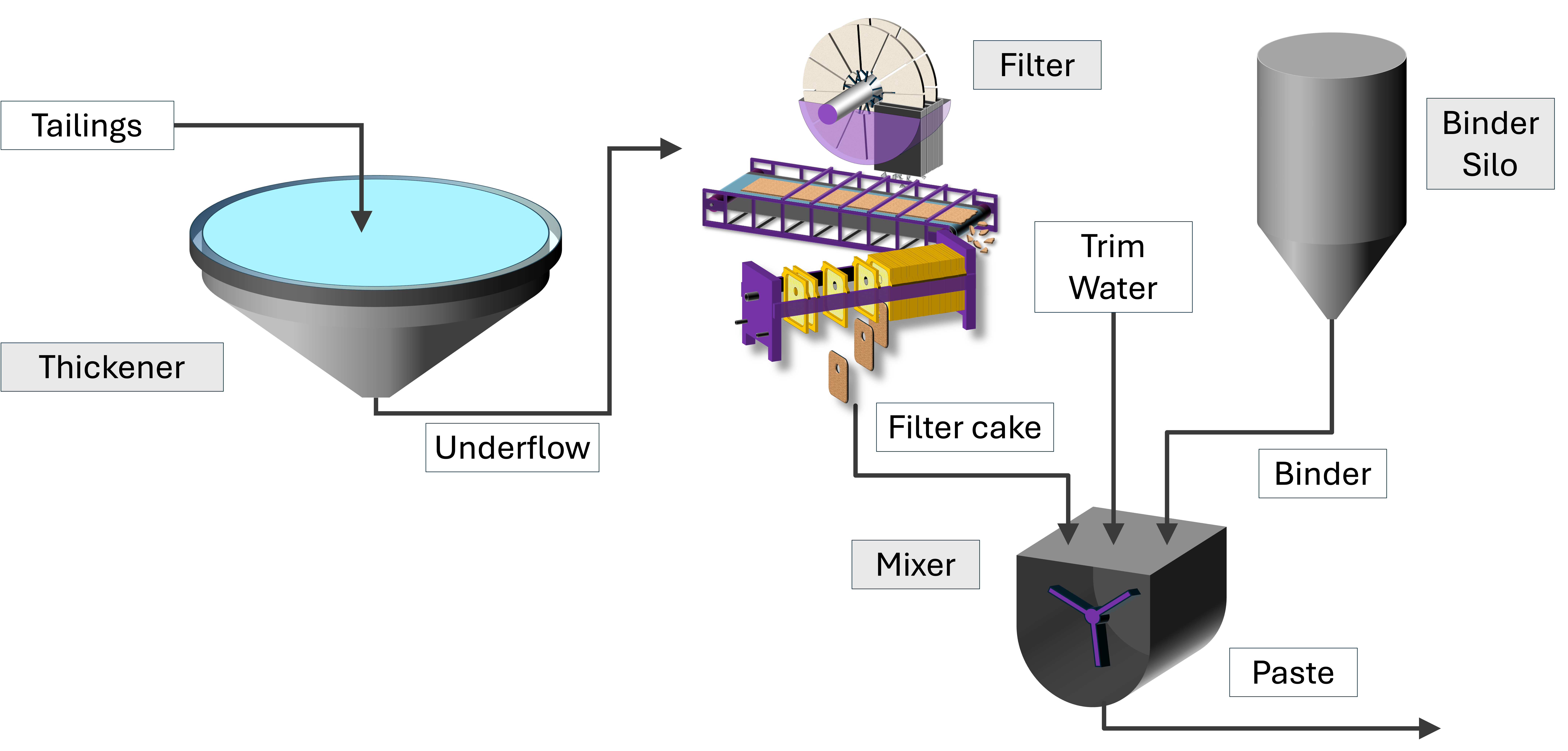
The dominant process philosophy is to dewater the tailings beyond the target paste solids concentration, which can vary significantly depending on material properties and orebody geometry but typically falls between 60-80 %w.w, and gradually add trim water or slurry to the decrease to the desired consistency. This approach is preferred as it is much easier to add more water to a cementitious mixture than is to take water out!
Various binders can be used including cement, slag, fly ash, or even cementitious clays. Selection of a binder is a trade-off between local availability, cost and performance. A requirement for performance regardless of binder type, is effective mixing and achieving a homogenous paste, poor mixing can lead to clumping and nodules of tailings or binder reducing the quality of the paste.
The second stage of a paste backfill system is the reticulation system; this is a pipe network that hydraulically connects the paste plant to every stope where paste backfill is needed. The paste can either flow via gravity or be driven by a positive displacement pump. These networks are often vast spanning multiple km in length and over 1km deep, with hundreds of branching points to access different orebody regions. 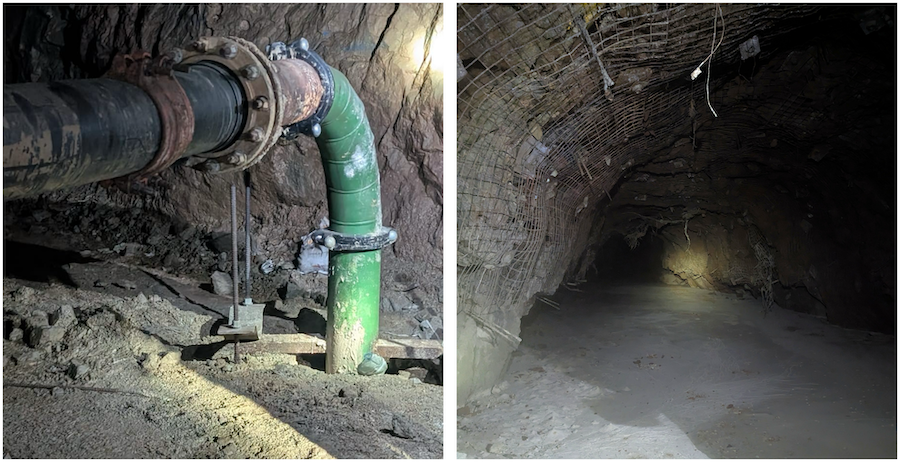 Design and management of these networks is the most challenging part of a paste backfill system. The reticulation system design defines the physical constraints on the paste consistency, requiring continuous monitoring of line pressures and adjustments to process set points to operate within this constraint window. For a given route there is an upper limit to paste solids concentration, above this the paste becomes too thick to be feasibly delivered – pressures exceed pipe ratings or available driving head. Likewise, there is a lower limit, as the paste becomes too thin there can be an excess in driving head (from elevation change) resulting in slackflow.
Slackflow is a hydraulic phenomenon where the paste fluid partially vaporises to balance the hydraulics of the network, within the region of slackflow there is considerably elevated wear rates due to high particle velocities and cavitation, leading to premature failure of the piping.
Paste backfill performance is directly related to the tailings material composition, variance in mineralogy, particle size distribution, and any upstream process can affect both the rheology and geotechnic performance of the paste. Reticulation system design must account for this variance, by simulating the system hydraulics under dynamic conditions to determine real world operability.
Backfill design is dictated by the geotechnic requirements of the stope, the composition of the paste, and curing time before the next stope is taken and the backfill is exposed. Process variance introduces uncertainty regarding the paste quality, which can adversely affect the production schedule or lead to overly conservative designs, increasing binder usages and costs. Machine learning algorithms can be used to developed strength prediction models, these models can ingress real-time SCADA data streams to reduce uncertainty of paste quality and dynamically design around variance.
Additional process stages can be included in the paste plant to mitigate or alleviate the pressure of tailings variance, these include hydrocycloning or blending with aggregate to control the particle size distribution, or adding admixtures to improve material rheology or geotechnics. Identifying the best paste backfill solution requires extensive trade-off analysis of all possible materials, binders, process modifications and additives, this can be achieved through stochastic design software.