
Water recovery
Trevor Sparks from Kipinat Ltd takes a closer look at water recovery from a tailings stream.
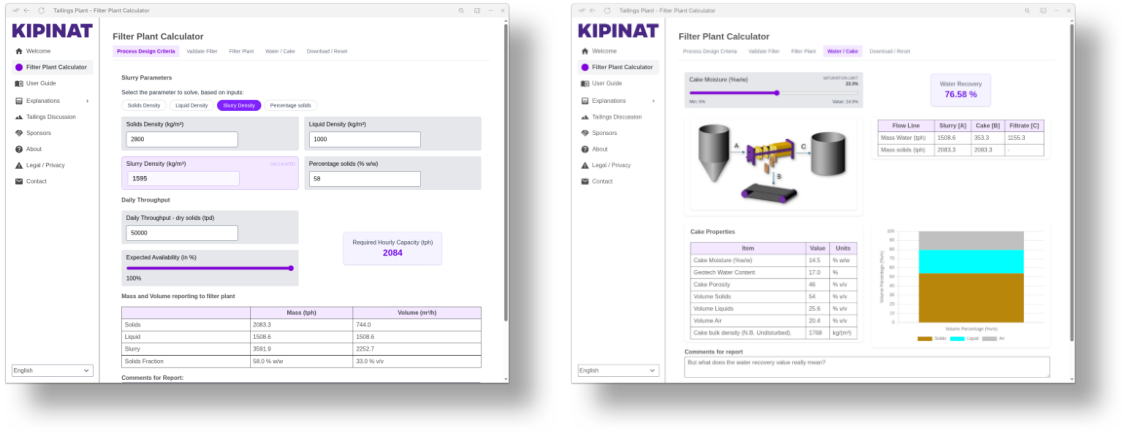
With tailingsplant.app you can establish a value for ‘Water Recovery’. But what does it mean?
In a conventional mill concentrator (crushing — grinding — flotation) water is the essential medium. Understanding water sources and sinks, as well as the amount of water that needs to be extracted and returned to the environment, can be a vital part of understanding both cost of production as well as constraints on that production.
For a throughput of 50,000 tonnes per day (dry solids) and with solids and liquid densities of 2,800 and 1000 kg/m³, the Process Design Criteria and Water/ Cake tabs of the Filter Plant Calculator can be used to find the volume flows of liquid through the process, based upon the values that you give for solids content.
This illustration assumes that slurry emerges from the concentrator at 40 %w/w, reports to Filtration after Thickening at 58 %w/w and the final filter cake is at 14.5 %w/w moisture (or 85.5 %w/w solids). The table below shows (in the 3rd column) the amount of water that, without any further treatment will report to Tailings Storage. The next column shows the percentage of water that is “recovered” from the previous stage (after thickening as Overflow and after filtration as filtrate). Finally, the last column shows the water “recovered” overall from the original tailings slurry.
| Stage | Solids (% w/w) | Volume water (m³/h) | “Recovered” from previous stage (%) | “Recovered” overall (%) |
|---|---|---|---|---|
| Tailings from concentrator | 40 | 3125.0 | - | - |
| After thickening | 58 | 1508.6 | 51.7 | 51.7 |
| After filtration | 85.5 | 353.3 | 76.58 | 88.69 |
One of the undoubted outcomes of tailings thickening and filtration is that this water is available immediately. There is no need to send water to the TSF and wait for it to return via a series of lagoons and return pumps, all the time suffering losses to evaporation or seepage.
However…
…this is all very neat and simple, and here is where it begins to get more complicated and interesting…
We won’t attempt to produce a full discourse here on water management in mining, but we can look at some of the complications as well as other issues that need to be included in any assessment of tailings dewatering.
1. You need water to run dewatering plants
Water is required to run thickening and, especially, filtration plants. Pipes, plate packs and filter cloths need to be cleaned. And, particularly if spray nozzles are used, at least some this water needs to be very clean. This is not factored into the scenario above. However, appropriate water treatment using, for example clarifiers and polishing filters, can be provide this water.
2. Water does not have a globally-harmonised cost
Water can cost a lot more 4km up a mountain range than it does in a rainforest. If water is to be given a value and used as a part of an economic model of the mine, then this needs to be considered.
3. Water Constraint.
Aside from the cost of water, if an operation has limited consent to draw water from local sources, then production may be severely constrained, as these news articles show .

4. Local climate, topography and geology
Management of water in, and recovery from, TSFs can depend greatly upon rainfall, evaporation as well as suitability of the terrain for storing water in lagoons or ponds..
5. This water might not be the same as that water.
As water passes through a mineral processing circuit, it will be collecting soluble reagents (for froth generation as well as suppression, coagulants and flocculants and, perhaps, salts leaching from the minerals…). If water passes repeatedly through the circuit then these may build up to the point where they have reached a concentration that affects the success of the process itself. This will be very mineral and process design-specific, but requires attention.
So..
There is no question that tailings dewatering can capture water before it goes to the TSF, provide a greater level of control, potentially unlock process constraints as well as reduce overall water costs. This is all in addition to other benefits, such as the far higher geotechnical stability of the facility.
We hope that tailingsplant.app can help you assess these issues in the round.